|
|
|
Viking Age Arms and Armor
Viking Sax
 |
Much of the text presented on this page is out-of-date. Until we find time to make the needed updates to this page, we strongly encourage readers to look at this topic as it is presented in our new book, Men of Terror, available now from your favorite book seller. |
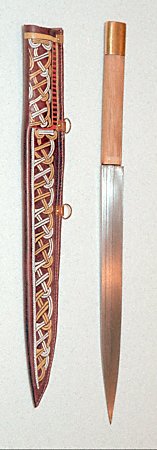 |
A sax is a short sword that was used primarily during the early part of the Viking era. It's a one handed single edged weapon with a blade length ranging from 30 to 60cm (12 to 24 in). Saxes usually had simple fittings and no crossguard. Hilts were made of wood, bone, or horn.
|
|
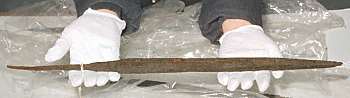
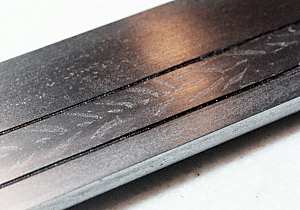
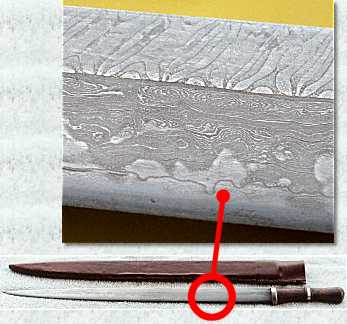
At least a few sax blades were every bit the equal of the finest sword blades from the period. The reproduction sax shown to the right is based on an historical 8th century sax found in the Netherlands. The inset image shows a detail of a small part of the blade. Like the historical original, this blade is a work of art, showing extremely fine craftsmanship. |
 |
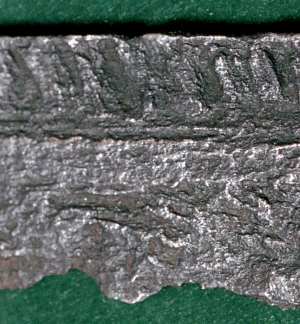 |
A detail from a historical pattern welded sax blade is shown to the left. The same kind of pattern welding as seen in the reproduction blade above is visible in this historical blade. The strong backbone has coarse twists, while the blade has much finer twists. |
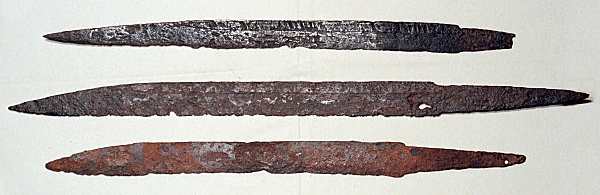 |
Saxes had a characteristic blade-shape with parallel edges, a pointed tip, and a broken (rather than straight) back near the point. Three historical sax blades are shown to the left. |
|
Another form of sax that is found has a gently curving back and tang. A sketch of a historical example is shown to the right. |
 |
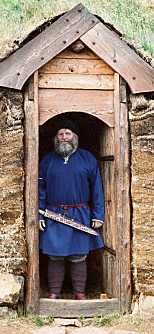 |
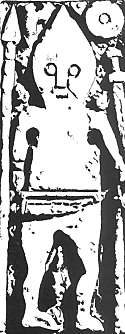
Saxes were usually carried in a sheath suspended horizontally from the belt. A 10th century burial cross in a churchyard in Middleton, Yorkshire shows a warrior surrounded by weapons (right). The sax is shown suspended from his belt. Saxes were carried with the blade upward, so the sharp edge didn't cut through the sheath. As a result, the bottom edge of the sheath mirrored the broken back shape of the sax. Different length saxes are sometimes referred to by different names, such as langsax or scramasax. However, the usual term that appears in the saga literature is sax and, rarely, but equivalently, höggsax and handsax. Some people preferred a sax over a sword for fighting. In Grettis saga for instance, Grettir preferred his sax, called Kársnautr, which he took from Kár's grave mound. |
 |
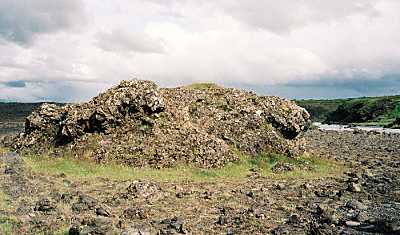
One of the more memorable descriptions of the use of a sax in a fight occurs in Brennu-Njáls saga, at the fight on the Rangá described in chapter 63. Kolr thrust at Kolskeggr with his spear while Kolskeggr had his hands full with other opponents. The spear went through Koskegg's thigh. Kolskeggr stepped forward and cut off Kol's leg with his sax, and he asked, "Did that hit you or not?" Kolr replied that it was what he deserved for not shielding himself. He stood looking at his leg stump. Kolskeggr said, "You don't need to look: it's just as you think, the leg is gone." Then Kolr fell down dead. The fight took place near the boulder Gunnarsstein adjacent to the Rangá river, shown to the right as it appears today. |
 |
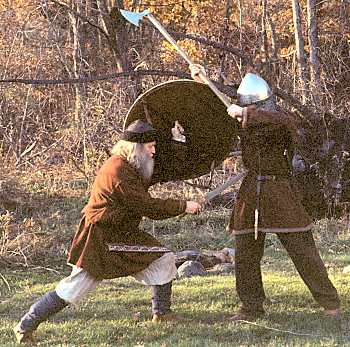 |
In general, many of the techniques used with the Viking sword and shield seem to apply equally well to sax and shield. The lack of a second edge on a sax prevents the use of any short edge attacks, and the shorter blade means that attacks are likely to be made from shorter range. The short blade also means that it is more easily hidden behind a shield, ready for a quick, unexpected thrust or slash from behind the shield (left). |
|
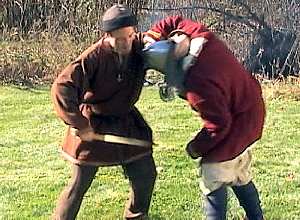
A sax was a handy reserve weapon, easily drawn to finish the fight (right). A speculative reconstruction of the move is shown in this combat demo video, part of a longer fight. |
 |
 |
Saxes, like any other Viking age weapons, were valuable. When they were damaged or worn, the iron was repurposed, and used for some other tool or weapon, such as a knife |
|
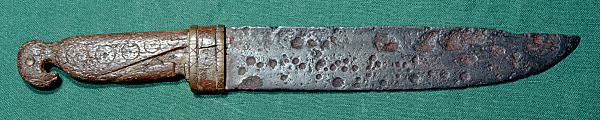
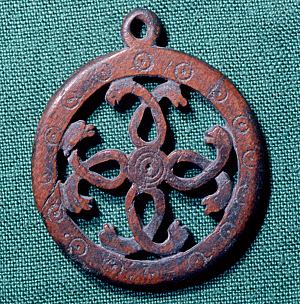
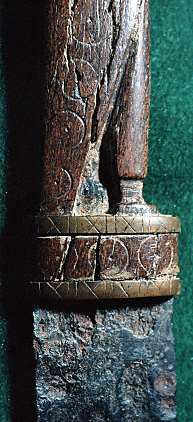
This exquisite historical knife shown above was thought to be from the Viking age, but recent dating of other carved wooden objects in the same find suggest that they date from the Migration era, which predates the Viking era. Regardless, Viking-age knives were similar. The carved medallion shown to the right is from the same cache of carved wooden objects, and may have come from the hand of the same woodsmith. |
 |
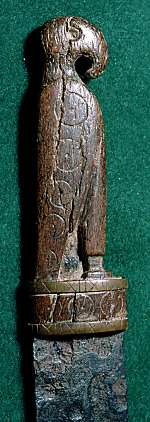 |
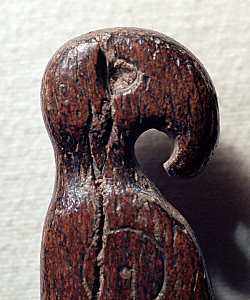
This knife was probably made from a cut-down sax blade. The blade is pattern welded, and the fittings, shown in more detail to the left and right, are magnificent. The grip is in the form of a bird, with decorations incised into the wood and bronze making up the grip. The total length of the knife is 31cm (12.5in). X-ray images show that the tang is quite short.
|
 |
|
Viking-age knives resemble saxes in many regards, and often, the only distinguishing feature is the length of the blade. One convenient dividing line is 8 in (20cm); longer blades are considered saxes, while shorter blades are considered knives. Knives are very common grave finds in Viking-age burials, and some of the knives from the Viking age are quite small. |
|
|
|
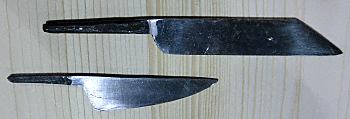
Knives from graves tend to have a shape that depends on the sex of the person in the grave. Knives from men's graves tend to be straight-bladed with a broken back (top) while knives from women's graves tend to have a curved blade (bottom). Perhaps this difference is due to the differing tasks performed by men and women with their knives. |
One has the impression that one's knife was a constant companion, always carried throughout the day. It seems likely that knives were carried on the belt in a sheath. A belt knife is sometimes mentioned as the gift of last resort for a man who needed to offer a gift to someone. In Gísla saga (ch. 27), Gísli gives his knife and belt to Refur for saving his life and hiding him for two weeks after he had already given away all his other valuable possessions to others who had aided him earlier.
On the other hand, Eyrbyggja saga (ch. 58) says that most people carried their knives around their necks in the saga age. Finnboga saga (ch. 40) tells us that Finnbogi used his neck knife to kill a man after bringing him down with grappling.
Other specialized knives are mentioned in the sagas, such as the tálguknifur, a knife used for woodworking. Björn was using such a knife to widen the mortises on the runner of his sled (Eyrbyggja saga, ch.47) and subsequently placed the point on the chest of Snorri goði to threaten his life.
|
|
<< Previous article |
Back to Arms and Armor |
Next article >> |
 |
©1999-2026 William R. Short |