|
|
|
Viking Age Arms and Armor
Viking Axe
 |
Much of the text presented on this page is out-of-date. Until we find time to make the needed updates to this page, we strongly encourage readers to look at this topic as it is presented in our new book, Men of Terror, available now from your favorite book seller. |
|
When people think of Viking age weapons, they usually think first of the battle axe, and the image that forms in their mind is a massive weapon that only a troll could wield. In reality, battle axes in the Viking age were light, fast, and well balanced, and were good for speedy, deadly attacks, as well as for a variety of nasty, clever moves.
Axes meant for battle were designed a bit differently than farm axes. |
|
|
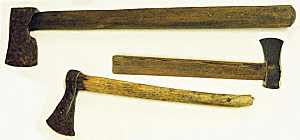
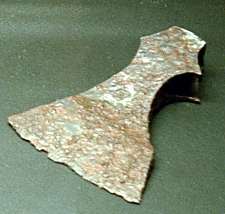
The photo to the left shows two reproduction battle axes based on 10th century finds, while the photo on the right shows a historic 10th century axe head. Axe heads were made of iron and were single edged. |
 |
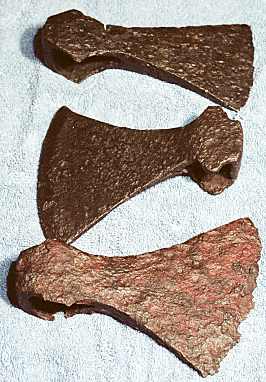 |
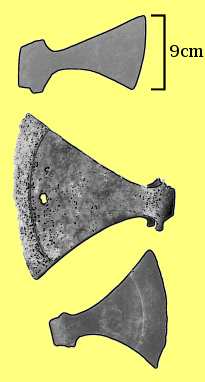
A wide variety of axe head shapes were used in the Viking age. The sketch to the right shows three different 11th century axe heads, while the photo to the left shows three earlier axe heads. In the early part of the Viking era, the cutting edge was generally 7 to 15cm (3-6in) long, while later in the Viking age, axes became much larger. Breið-øx (broad axes) had crescent shaped edges 22 to 45cm (9-18in) long. The cutting edge of the largest of the axe heads shown to the right is 22cm (9in) long. The edge of this axe is made of hardened steel welded to the iron head. The join line is clearly visible in the sketch and in the historical axe head. The steel permitted the axe to hold a better edge than iron would have allowed. |
 |
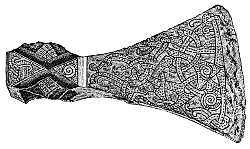 |
Some axe heads were elaborately decorated with inlays of precious metals, notably the Mammen axe head. The head is decorated on every flat surface with inlays of silver and gold and was found in a rich grave that dates from the year 971. |
 |
 |
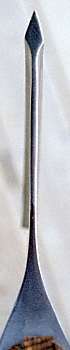 |
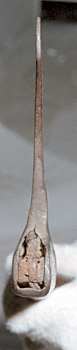
Typically, axeheads had a wedge-shaped cross section. The cross section of the head near the edge was sometimes diamond shape, which provided for greater strength for a given weight of iron. (A modern reproduction is shown in the near left photo, while a photo of a historic axe head with that diamond edge profile is shown to the right.) Fóstbræðra saga chapter 23 tells of a special axe made by Bjarni for Þormóðr, which was hammered all the way out to the edge with no obstructions, resulting in a very sharp blade. Some axeheads had very thin, elegant cross-sections. (A reproduction is shown in the middle left and a historic axe far left, all on similar scales). This axe is too thin and delicate for splitting wood; this axe is meant for splitting skulls. |
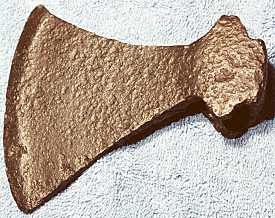 |
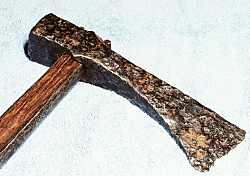 |
Some axe heads (notably thick, wedge shaped axe heads such as the one seen to the left) show evidence of having been made as a single piece, with the eye (the hole for the haft) punched out with a drift. |
| The thinner blades often show evidence of having been folded around what would eventually become the eye and welded together with a steel bit for the edge. In some cases, the wrap was symmetrical, while in other cases, the wrap was asymmetrical, with the weld just forward of the eye. |
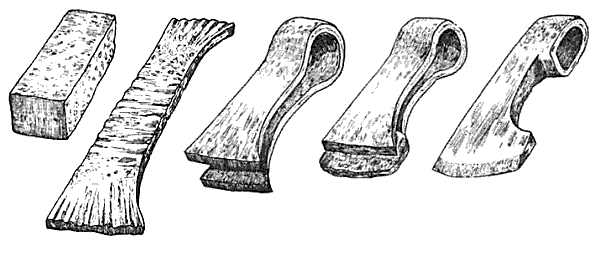 |
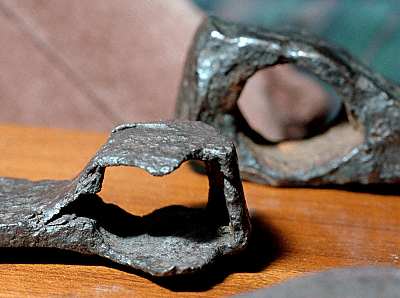 |
The photo to the left shows two historical Viking age axe heads. The axe head in the foreground shows evidence of having been folded around the eye, while the thick axe head in the background had the eye punched out with a drift. |
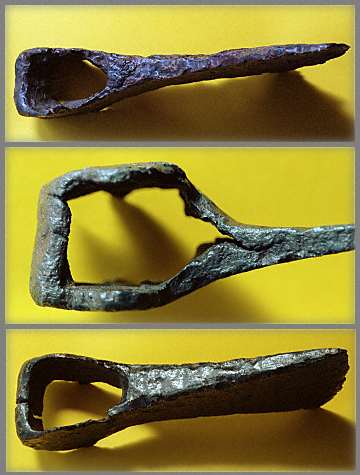 |
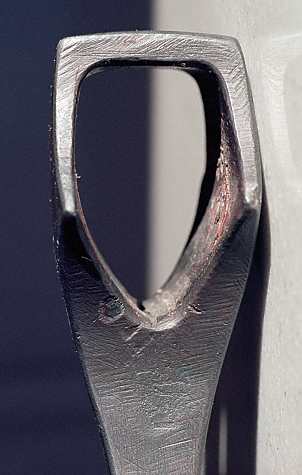
Some historical axe heads have a visible weld on the back side (the hammer side) of the eye. It has been suggested that these heads were fabricated by shaping the general form of the head, then splitting the back of the head through its thickness, creating a Y-shaped cross-section. The two arms of the Y were wrapped around to form the eye and forge welded together. A reproduction axe head made using this technique is shown to the right. The eyes typically were D-shaped or shield-shaped, rather than round, and the back (the hammer) was often flat and thicker than the sides, as can be seen on the three historical Viking-axe axe heads to the left, and in the reproduction axe head to the right. |
 |
I'm not aware of any archaeological evidence for double edged axe heads, nor of any mention of them in the stories. Some translators use "double-bladed axe" for the word bryntröll, but I believe that usage is unwarranted. As discussed in more detail in the article on miscellaneous weapons, we don't know what sort of weapon that bryntröll refers to. In chapter 2 of Valla-Ljóts saga, it is said that Ljótur carried a bryntröll when he was in a good mood. When he was in a killing mood, he carried a snaghyrnd öx (snag-horned axe). We don't know how this form differed from a normal axe.
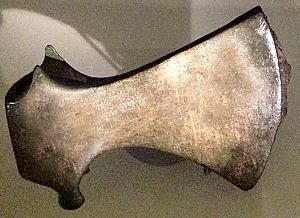 |
Virtually all Viking-age axe heads are iron (or steel), although a bronze axe head (left) was found in Iceland in a Viking age context, which raises a number of interesting questions about why bronze would have been used in this application. The head has an iron cutting bit, now heavily eroded. |
|
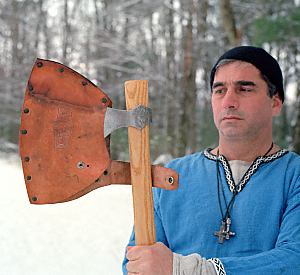
One wonders whether men used sheaths on their axes in the Viking age to protect against accidental cuts. There is little archaeological evidence to suggest their use, notably a few finds from Hedeby. The available literary evidence does not suggest they were used. In the Sagas of Icelanders, knives in sheaths are mentioned, saxes in sheaths are mentioned, swords in scabbards are mentioned, but there seems to be no mention of spears in sheaths or axes in sheaths. Indeed, there are more than a few examples suggesting that axes could be instantly put to use without any need to prepare them by, for example, removing the sheath. In chapter 144 of Íslendinga saga (which takes place well after the end of the Viking age), it is said that an unnamed man was accidentally wounded by an axe as men mounted their horses to ride to a killing in west Iceland. The episode suggests that the head of the axe was not covered. The sheath shown to the right is a modern reconstruction based on examples from well after the end of the Viking age. This replica axe is wickedly sharp, and my sense is that a sheath is essential unless one is extremely vigilant at all times. Perhaps that is what was done in the Viking age. |
 |
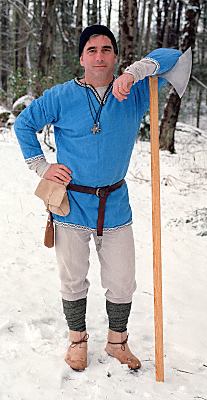 |
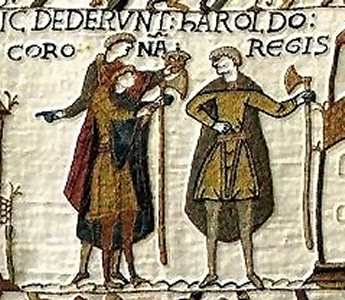
The axe haft was made of wood. One source (Kirpichnikov) suggests that axe hafts typically were 80cm long (32in). But surely, the haft was sized for the intended use of the axe and to balance the axe head. The Bayeux tapestry suggests axes with much longer hafts (right), and modern replicas with longer hafts (left) prove to be useful tools and powerful weapons. |
 |
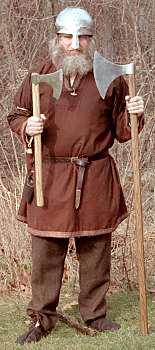 |
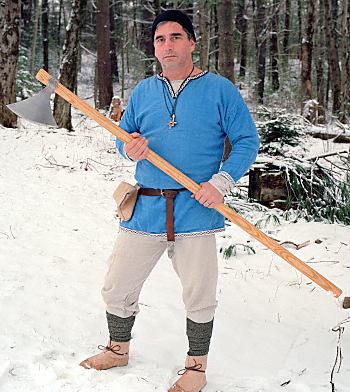
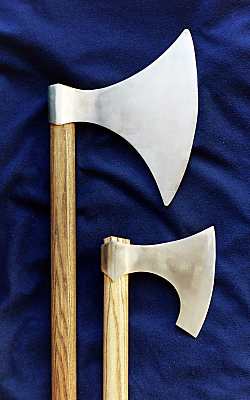
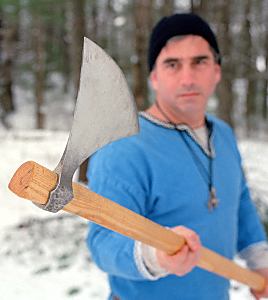
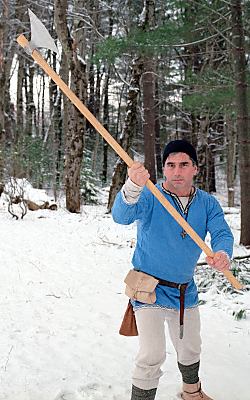
Axes with smaller heads no doubt had shorter hafts and were used one handed, while longer hafted axes were used two handed. Both of the reproduction axes shown to the left are nicely balanced, despite the obvious difference in the length of their hafts. The longer haft is 140cm (55in), while the shorter is 70cm (28in). The long reach of the two-handed axe is clearly visible in the photo to the right. There are a number of ways of affixing the head to the haft. One approach is to taper the eye of the axe head and the haft, so that the head fits firmly on the shaft and cannot fly off the end. However the head is fitted, the axe must resist both pulling and pushing forces. The sagas suggest that sometimes axe heads flew off their hafts in a fight (which must have been very discouraging for the fighter using the axe). Harðar saga (chapter 36) says that Hörður was encircled by his opponents. He was able to kill six men with his axe until the head came off the haft. Then Þorsteinn gullknappr was able to strike a blow with his axe that killed Hörður. |
 |
There's little information on the details of axe hafts used in the Viking age. Based on our work reconstructing Viking-age axe combat techniques, I have some preferences which may not be shared by other modern practitioners, nor by the Vikings who used these weapons in earnest 1000 years ago. The haft I prefer is straight, with little in the way of a flare or other stop at the butt end. Its sides are flattened, and the surface is smooth to facilitate sliding the hands along the haft so the the grip can be shortened or lengthened smoothly as the space between combatants changes during the fight. Needless to say, my modern preferences tell us nothing about the nature of axe hafts in the Viking age.
During the Viking age, axe hafts were probably created using riving. A detailed description of riving a Viking axe haft is here.
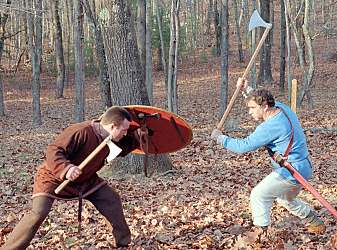 |
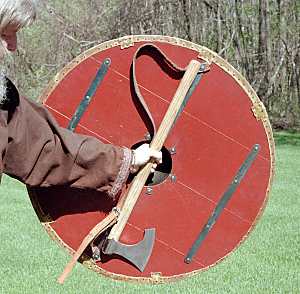
One advantage of axes with shorter hafts is that they can be easily hidden. An axe can be held in reserve behind a shield, a trick used by Þorgeirr in chapter 12 of Fóstbræðra saga. In a fight with Snorri, Þorgeirr threw down his spear and took up his hidden axe in his right hand, using it to cut through Snorri's spear shaft, and then through Snorri's head. |
 |
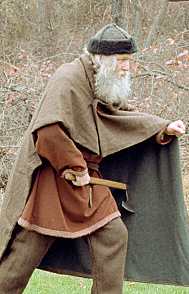 |
Small axes could be hidden under a cloak and used for a surprise attack (left). In chapter 22 of Fóstbræðra saga, Þormóður unexpectedly pulled an axe out from under his cloak and struck Loðinn in the head, killing him. A speculative reconstruction of that move is shown in this Viking combat demonstration video, part of a longer fight. |
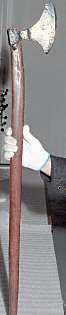 |
Some believe that the axe, being poorly balanced, was harder to control than a well balanced weapon like a sword. That is not the case for a well-made axe. The photos show a 12th century axe. The haft, while not original, is ancient. The total weight of the axe is only 770g (1.7 lb.), less than some swords. In the hand, it's beautifully balanced, fast, and is easily directed towards the target. It's hard to claim that an axe is brutish or sluggish after experiencing something as well balanced as this example. One advantage of an axe over other edged weapons is that the curved edge concentrates all the force of the blow into a small section of the edge, so the axe has enough power to punch through a helmet or mail. The sagas often mention axe blows that cleave the head down to the shoulders. A speculative reconstruction of that move is shown in this Viking combat demonstration video, part of a longer fight. |
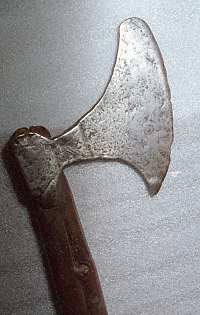 |
|
The curved shape of the head allows the axe to be used for a variety of moves. It can be used to hook an opponent's ankle, throwing him off balance and onto the ground. |
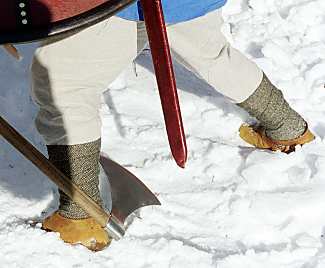 |
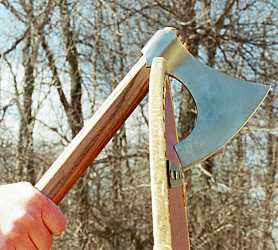 |
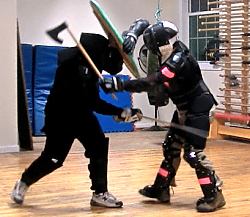
The axe head can be hooked over other body parts, such as the neck (right), to compel a person to move in a direction he doesn't wish to go. Chapter 22 of Sturlu saga describes how Þorsteinn hooked one of Sturla's men with his axe and dragged him over to where he could be stabbed. Additionally, the axe can be used to hook the edge of the shield (left), pulling it away for an attack, or for a disarm. Þorskfirðinga saga (ch. 10) says that Askmaðr ran around his opponent in an attempt to hook his shield away. A speculative reconstruction of this move is shown in this Viking combat demo video, as part of a longer fight. |
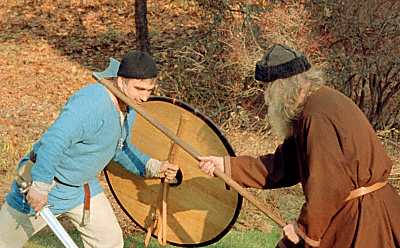 |
|
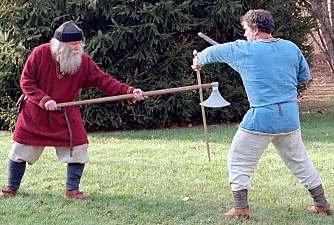
The pointed "horns" at each end of the head (öxarhyrna) were kept sharp so they could be used offensively, as was done by Kolbeinn in chapter 5 of Grænlendinga þáttur. He drove the horn of his axe into Þórð's throat, killing him. The horns can also be used for slashing attacks, such as across the belly. Because the axe horn widens so much more than a spear point or a sword point, the horns create vicious wounds when used for stabbing. |
 |
Axes (as well as other weapons) were sometimes used to strike a blow that was not intended to be lethal. The öxarhamar (axe hammer), the backside of the axe head, was used for that purpose. Sometimes, the blow was made to humiliate an opponent, or in other cases, was made against an opponent so inferior that he didn't seem worthy of a proper blow. In chapter 9 of Þórðar saga hreðu, Özurr and his men surrounded the cowardly Þórhallr and forced him to betray the location of his friend, Þórðr. Özurr struck at Þórhallr with the back of his axe, knocking him out, and said, "It's bad to have a slave as your best friend."
In at least one case, the axe hammer was used to strike an unintended but lethal blow. In chapter 146 of Brennu-Njáls saga, Þorgeirr rushed to attack Þorkell, but as he did so, another man came at Þorgeirr from behind. As Þorgeirr raised his axe in the backswing, the axe hammer struck the man behind on the skull, killing him. With the forward swing, Þorgeirr chopped off one of Þorkel's arms at the shoulder.
In chapter 16 of Ljósvetninga saga, the story is told where an axe was used where a more suitable tool might have served better. Once when he was young, Guðmundr used his hand to wave mosquitoes off the bald spot of his foster father while the old man napped outside. His brother Einar suggested he use his axe, instead, to drive the mosquitoes away. Guðmundr took the advice, drawing blood from the old man's head. Only then did Guðmundr realize that Einar's advice was not well intended. The bad blood between the brothers continued into adulthood.
|
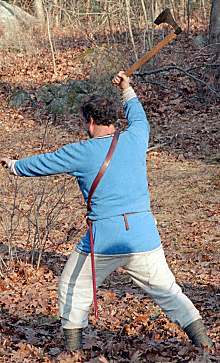
It seems unlikely that axes were routinely thrown in fights, but in desperation, men did whatever was necessary to succeed, including throwing their axe. One example is told in chapter 33 of Harðar saga og Hólmverja. In a battle, Þorvaldr drove a spear through Sigurðr, who had been fighting with an axe. Sigurðr threw his axe at Þorvaldr, hitting him in the head. They both fell down dead. The sense of the story is that the axe was Sigurð's normal battle axe, rather than a specialized throwing axe. In chapter 64 of Laxdæla saga, Helgi Hardbeinsson received a serious wound in a fight. Turning to the others, he said, "This old fellow still dares to face others," and he threw his wood axe at Þorgils, causing a serious wound. The battle at Stiklastaðir (which occurred on 29-July-1030) is described in chapter 226 of Óláfs saga helgi. The saga says that large numbers of armed men fought on each side. Men in the front rank used their swords, while those in the next rank thrust with their spears. Men in the rear shot arrows and javelins and threw stones and hand-axes (handöx) at the opposite side. |
 |
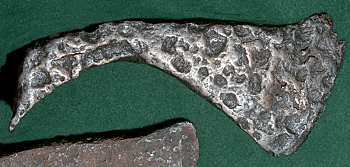 |
The historic axe head shown to the left resembles Frankish throwing axes that predate the Viking age. Perhaps some of these axes were still in use and found their way to Norse lands in the Viking era. |
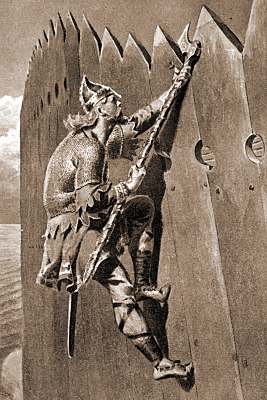 |
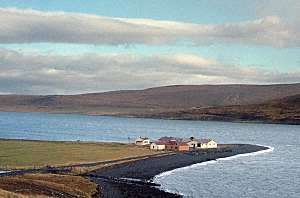
Other clever moves with axes are described in the sagas. In chapter 62 of Eyrbyggja saga, Þrándr leapt up and hooked the head of his axe over the wall of a fortification at the farm at Eyrr (shown to the right as it appears today). He pulled himself up by his axe handle into the fortification and cut off Hrafn's arm with his axe. The story doesn't describe the details of the fortification (virki). |
 |
|
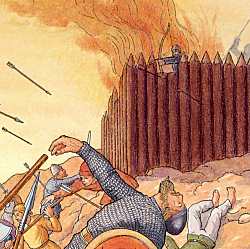
The sketch to the right shows a wooden fortification that has some elements consistent with the fortifications described in the sagas, including a rampart at the top of the fortification from where combatants could hurl missiles towards the combatants outside. In the battle at Eyrr described above, Óspakur repeatedly went out on to the fortification to hurl stones at Snorri's men. While thus exposed, Snorri threw a spear at Óspakur, wounding him so that he fell out of the fortification where Snorri could kill him. |
 |
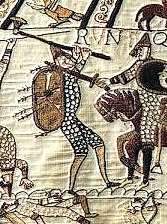 |
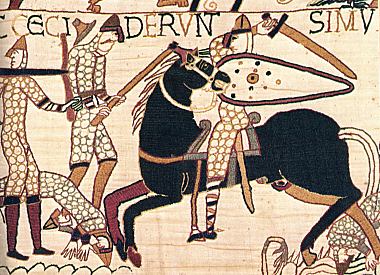
Pictorial sources teach us about axe techniques. For example, images from the Bayeux tapestry (left and right) show combatants using their axes two-handed, but left-handed. Thus, the blows come in on the undefended side of their opponents. |
 |
The sagas suggest that occasionally axes failed during use. There are many examples where axeheads shattered, notably when they hit a stone or other hard object (e.g., Egils saga chapter 38, and Eiríks saga rauða chapter 11).
Another type of failure was described earlier in this article, in which the head flies off the haft as told in chapter 38 of Harðar saga og Hólmverja.
|
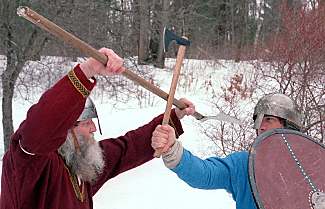
Axe hafts were used for defense, which sometimes resulted in failure of the haft. In chapter 16 of Króka-Refs saga, Narfi came upon Grani as he was making unwelcome advances on Narfi's wife. Narfi thrust repeatedly with his spear at Grani, who had an axe in his hand. Grani parried the thrusts with his axe, but eventually Narfi ran him through. Narfi dragged the body away and covered it while Grani was still in his death-throes. In chapter 21 of Fljótsdæla saga, Þorkell drew his sword and struck at Gunnar. Gunnar raised his axe over his head to parry, and the sword hit the axehead such that it stuck in the axehead. Gunnar raised the axe further to stop the fight. In chapter 58 of Eyrbyggja saga, Óspakr parried a blow with his axe. The blow struck the haft, breaking it in two. |
 |
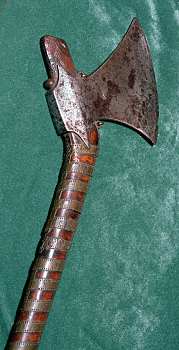 |
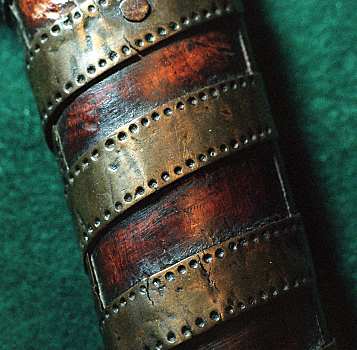
The sagas say that axe hafts were sometimes wrapped with iron or other metals to reduce the possibility that the haft would break when used to parry edged weapons, or when otherwise stressed. Brennu-Njáls saga (ch. 87) says that Hrappr Örgumleiðason carried an axe with a wrapped shaft (vafinskepta). Hrappr used the axe several times in the saga, notably to cut in two the backbone of Ásvarðr, who had been charged with protecting Guðrún, whom Hrappr was trying to seduce. When Guðmundr later saw the axe and asked why it was bloody, Hrappr replied that he had been taking care of Ásvarðr's backache. The historical axe shown to the left dates from after the end of the Viking age, but shows how axe hafts might have been wrapped in the Viking age. A detail of the wrap is shown to the right. The haft is probably not original, but it is certainly ancient. The bend near the head is clearly intentional, part of the design of the weapon. The bend helps maximize the transfer of power from arm, shoulder, and upper body to the contact point of the edge with its target. The weapon jumps into the hand and becomes a natural extension of the arm. |
 |
It's highly likely that a haft of this type was made from wood that naturally grew with that bend. The grain of such a piece of wood would follow the bend, resulting in a very strong haft.
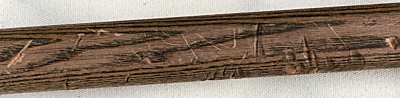 |
The need for such haft protection is graphically demonstrated by the divots in the haft of my replica axe (left). Even though we use blunt-edged weapons, the haft has been scarred by the hits it has received in demonstrations and practice sessions. It's easy to believe that a sharp weapon would have caused significantly more damage, possibly resulting in the failure of the haft. Iron protection would have reduced that risk. |
|
In our Viking combat training at Hurstwic, we use training axes made by Wechter Arms. |
|
|
|
<< Previous article |
Back to Arms and Armor |
Next article >> |
|
©1999-2026 William R. Short |